
 Get a Free Quote
 Home /
How to Choose Jumbo Thermal Paper Rolls for Slitting and Converting?
Related Posts
How to Choose the Right Adhesive Label Material for Your Application?
Jul 27, 2026

How to Choose Carbonless Paper for Multi-Part Business Forms?
Jul 26, 2026
How Do You Calculate Thermal Paper Roll Length from GSM and Diameter?
Jul 25, 2026
How to Choose Jumbo Thermal Paper Rolls for Slitting and Converting?
Jul 23, 2026
For paper converters, choosing the right jumbo thermal paper rolls can make a big difference to production efficiency. A reel that looks suitable on paper may still cause problems during slitting, including uneven winding, excessive edge waste, or inconsistent finished roll lengths.
The most important factors are parent roll width, GSM, paper thickness, coating quality, core dimensions, winding consistency, and expected slitting yield. Buyers should also confirm that the material matches their converting equipment and the specifications of the finished receipt rolls.
Here's what to check before placing a bulk order.
1. Start with Your Finished Roll Requirements
Before comparing jumbo thermal paper suppliers, define what your converting line needs to produce.
For example, a factory making 80mm POS receipt rolls will have different slitting requirements from one producing 57mm rolls or multiple sizes on the same machine.
Start with these questions:
- What finished roll widths are required?
- What are the target outer diameters and roll lengths?
- Which paper grades will be converted?
- What core dimensions do the finished rolls need?
- Will the production line handle multiple widths?
Once these details are clear, choosing a suitable parent reel becomes much easier.
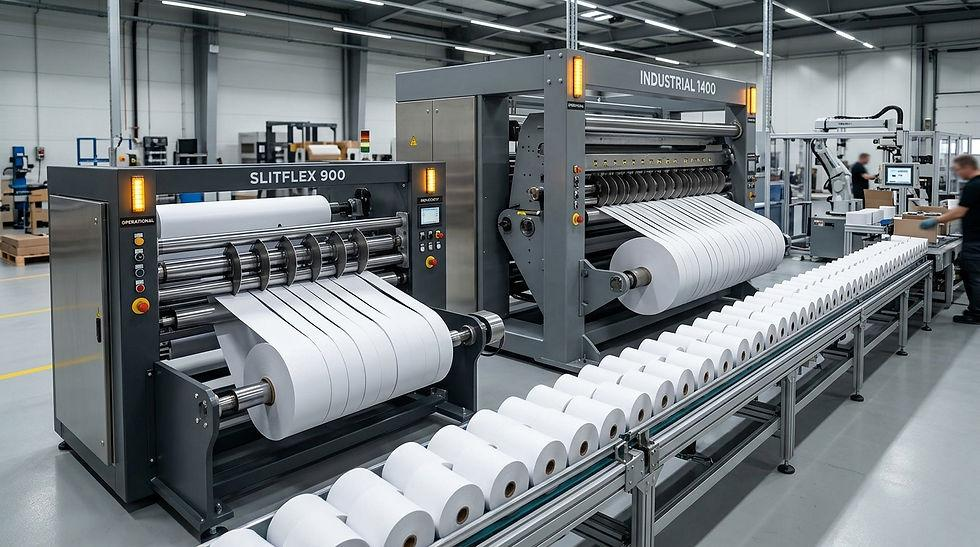
2. Choose the Right Jumbo Roll Width
Parent roll width directly affects how efficiently the paper can be slit into smaller rolls.
A wider reel isn't automatically more economical. What matters is how well its usable width matches the finished roll sizes.
For example, consider a converting operation producing 80mm-wide receipt rolls.
| Parent Reel Width | Theoretical 80mm Lanes | Remaining Width |
|---|---|---|
| 800mm | 10 | 0mm |
| 850mm | 10 | 50mm |
| 1,000mm | 12 | 40mm |
| 1,200mm | 15 | 0mm |
These figures are simplified mathematical examples. Actual production requires allowances for edge trimming, blade configuration, machine limits, and applicable width tolerances.
A reel with an apparently perfect lane count may still require edge trimming.
When choosing a jumbo width, ask your converting team to calculate the practical usable width rather than relying only on the nominal reel size.
3. Check GSM and Paper Thickness
GSM describes paper weight per square meter, while thickness describes the physical space occupied by the paper.
Common thermal paper grades include 48gsm, 55gsm, and 65gsm.
For converters, both measurements matter.
Lighter paper grades may allow longer finished rolls within a fixed diameter when their actual thickness is lower. Heavier grades may offer a more substantial feel, but they also affect material consumption and the number of meters produced.
However, GSM alone does not determine roll length.
Before ordering, confirm:
- Basis weight in gsm
- Paper thickness in microns
- Acceptable manufacturing tolerances
- Target finished roll length
- Compatibility with the intended printers
A small difference in paper thickness can become significant across thousands of finished rolls.
4. Evaluate Thermal Coating Quality
The thermal coating is responsible for image formation in direct thermal printers.
For a converter, coating consistency matters because a single jumbo reel may be used to produce many finished receipt rolls.
Inconsistent coating performance can create variation between finished products.
When evaluating samples, check:
- Print density and sensitivity
- Barcode readability
- Background appearance
- Coating uniformity
- Surface condition
- Resistance to specified handling conditions
For products exposed to moisture, oils, or frequent handling, ask whether a suitable protective coating is available.
Remember that higher GSM does not automatically indicate a better thermal coating.
5. Confirm Core Size and Converting Machine Compatibility
Jumbo reel dimensions must match the mechanical limits of the slitting and rewinding equipment.
Before purchasing, confirm the required core inner diameter, parent roll outer diameter, maximum reel weight, and acceptable reel width.
Also consider the handling equipment used to load and unload the parent rolls.
A reel may have the correct paper width but still be unsuitable if it exceeds the machine's weight capacity or unwinding limits.
Sharing your slitting machine specifications with the supplier helps prevent avoidable compatibility problems.
6. Inspect Winding Quality and Reel Condition
Good winding quality supports smooth unwinding and stable production.
Poorly wound jumbo rolls may cause web tension fluctuations, telescoping, wrinkles, or edge damage.
These issues can interrupt production and increase waste.
Before approving a bulk shipment, check the reel's:
- Winding consistency
- Edge alignment
- Core condition
- Visible wrinkles or deformation
- Packaging and handling condition
Converters should also confirm the coating-side orientation and unwinding direction.
The correct winding arrangement helps ensure that the coated surface is properly oriented during downstream processing.
7. Calculate Slitting Yield Before Comparing Prices
The purchase price of jumbo thermal paper is only one part of the total converting cost.
A cheaper reel may create higher expenses if its width results in excessive trimming or its winding quality causes production interruptions.
One useful metric is the usable-width yield.
Usable-Width Yield (%) = Total Finished Slit Width ÷ Parent Reel Width × 100
For example, if an 850mm parent reel produces ten 80mm lanes:
800 ÷ 850 × 100 = 94.1%
The remaining 5.9% represents unused nominal width before considering other production losses.
Actual material yield also depends on edge trimming, startup waste, damaged stock, web breaks, and other converting losses.
For large-volume operations, even relatively small improvements in usable yield can reduce material waste.
8. Check Packaging and Storage Requirements
Thermal paper is sensitive to heat, strong light, and certain chemicals.
Jumbo reels should be protected from moisture, contamination, and physical damage during transportation and storage.
For bulk imports, discuss:
- Protective reel wrapping
- Moisture protection
- Pallet and loading arrangements
- Reel labeling and batch identification
- Storage and handling instructions
Packaging should support the reel's size, weight, and transportation conditions.
Before loading reels into the converting line, inspect them for visible damage and check that the material has been stored under suitable conditions.
9. Request Samples and Confirm Quality Standards
For a new paper grade or supplier, production trials are a practical way to evaluate suitability.
Ask for representative material and run it under normal converting conditions.
During the trial, observe:
- Unwinding stability
- Slitting edge quality
- Paper dust generation
- Finished roll dimensions
- Rewinding consistency
- Thermal printing performance
Record the results and agree on measurable acceptance criteria before placing repeat orders.
For larger purchases, it can also be useful to confirm how production batches are identified and how quality concerns are investigated.
10. Prepare a Jumbo Thermal Paper Roll Specification Sheet
A clear specification sheet helps avoid misunderstandings between buyers and suppliers.
| Specification | Information to Provide |
|---|---|
| Material | Direct thermal paper jumbo roll |
| Paper Grade | Required GSM |
| Thickness | Caliper in μm |
| Parent Roll Width | Required width in mm |
| Outer Diameter | Maximum or target diameter |
| Core Size | Inner diameter and applicable tolerances |
| Coating | Standard or specified protective grade |
| Winding | Coating-side orientation and unwinding requirement |
| Reel Weight | Maximum allowed by the converting line |
| Packaging | Protective wrapping and pallet requirements |
| Quantity | Required tonnage or number of reels |
Not every supplier will offer the same specifications, so confirm actual available grades and production limits before issuing a purchase order.
Frequently Asked Questions
What is a jumbo thermal paper roll?
A jumbo thermal paper roll is a large parent reel of heat-sensitive coated paper. Converters use slitting and rewinding equipment to turn it into smaller finished rolls for receipts, transactions, and related direct thermal printing applications.
How do I choose the right jumbo thermal paper width?
Start with the widths of your finished rolls and the working limits of your slitting machine. Calculate the number of usable lanes and allow for edge trimming and production tolerances.
Does a higher GSM improve thermal paper quality?
Not necessarily. GSM measures paper weight, while printing performance depends on coating sensitivity, surface properties, printer settings, and other material characteristics.
How can converters reduce thermal paper slitting waste?
Select parent reel widths that match finished product dimensions, maintain suitable blade and winding conditions, inspect incoming material, and track production losses to identify recurring problems.
Final Thoughts
Choosing jumbo thermal paper rolls is ultimately about matching the material to your converting process.
The right parent reel should provide suitable width utilization, consistent paper properties, stable unwinding, and reliable thermal printing performance.
Rather than comparing suppliers by price per ton alone, consider usable output, production efficiency, material quality, and handling requirements.
Looking for jumbo thermal paper rolls for your converting operation?
Explore Mufeng Paper's thermal paper jumbo roll products and share your required GSM, reel width, core size, outer diameter, and order quantity to discuss available material options.
Share on Social:


Contact Us
In This Article
Show All
Collapse
Related Posts
How to Choose the Right Adhesive Label Material for Your Application?
Jul 27, 2026
How to Choose Carbonless Paper for Multi-Part Business Forms?
Jul 26, 2026
How Do You Calculate Thermal Paper Roll Length from GSM and Diameter?
Jul 25, 2026
How to Choose Jumbo Thermal Paper Rolls for Slitting and Converting?
Jul 23, 2026